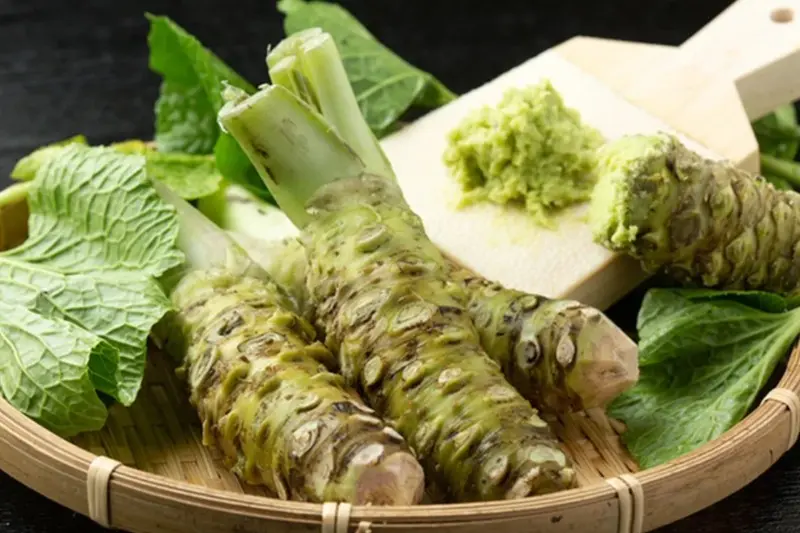
What you have been served is not wasabi
Virtually all the wasabi served at sushi restaurants in the United States — and most of the world — is not wasabi. It is a mixture of horseradish, mustard powder, and green food coloring. The two plants are distantly related members of the Brassicaceae family, and the flavor profile has some overlap, but they are not the same thing.
Real wasabi (Wasabia japonica, 本わさび) is more aromatic and more complex. Its heat is gentler and shorter-lived — it rises through the nose and dissipates quickly, rather than burning the back of the palate and lingering. Where horseradish is blunt and aggressive, real wasabi is expressive and fleeting. The difference comes down to chemistry: horseradish produces almost entirely one sharp compound, while real wasabi produces a broader family of aromatic molecules that the imitation cannot replicate.
Grate only what you need, immediately before serving. The volatile aromatic compounds responsible for wasabi's distinctive flavor dissipate within one to two hours of grating. Paste stored overnight has almost no flavor left.
Where it comes from — and why it is rare
Real wasabi is difficult to grow. Wasabia japonica requires a specific set of conditions: clean, cold, flowing water; consistent temperatures (around 10–17°C); shade; and well-oxygenated, mineral-rich soil. These conditions occur naturally along mountain stream banks in Japan, and Shizuoka Prefecture — with its clean, spring-fed rivers — has been the center of Japanese wasabi cultivation for centuries.
Growers in the Pacific Northwest and California are cultivating Wasabia japonica with some success — the cool, wet climates of Oregon's coast and the Cascade foothills provide conditions close enough to those in Shizuoka. What they produce is real wasabi. Our supply comes from Shizuoka, but the existence of domestic growing operations means that fresh wasabi is becoming slightly less rare in the US than it was a decade ago.
How to grate wasabi properly
The traditional tool is a sharkskin grater (鮫皮おろし, samegawa oroshi) — a flat wooden paddle covered with dried ray skin. The micro-texture of the skin does not simply cut through the rhizome — it breaks the cell walls at a microscopic level, releasing and combining the volatile compounds (allyl isothiocyanate produced by the myrosinase-sinigrin enzymatic reaction) that give wasabi its aroma and heat. A standard metal cheese grater slices coarsely and loses these compounds faster. A fine metal grater is a workable substitute.
Grate using small circular motions. Some warmth from the hand is beneficial — slightly warmer conditions activate the enzymatic reaction more fully. Grate on a cool surface and the flavor will be a little flatter. The amount produced per minute is small — wasabi is grated to order, a portion at a time, not prepared in advance.
Pairings — where it works and where it does not
Fresh wasabi is versatile — it shows a different character depending on what it is paired with. With clean, delicate fish such as white fish and scallops, its crisp, fresh aroma — the quality imitation wasabi does not have — stands out. With fattier or more robust, umami-rich fish, fresh wasabi adds structure: it supports the aroma of the fat and the depth of the umami rather than covering it.
Bluefin Tuna — particularly the fatty cuts Otoro and Chutoro — is the clearest example: the fat carries the aroma and the gentle heat clears the palate between bites. Sashimi-grade salmon works the same way.
Hikarimono — the silver-skinned fish such as mackerel (saba), horse mackerel (aji), sardine, and kohada — are traditionally paired with grated ginger rather than wasabi. The sharpness and freshness of ginger suits the oily, assertive character of these fish better than the aromatic heat of wasabi. This is a house style preference worth knowing: if you are serving saba or aji alongside your wasabi course, set out fresh ginger as the condiment.
Beyond sashimi and sushi, fresh wasabi works well on soba noodles — the clean, slightly nutty flavor of cold soba is one of the best vehicles for fresh wasabi outside of fish. A small portion of freshly grated wasabi dissolved into the tsuyu dipping sauce transforms a simple bowl of soba into something entirely different from its tube-wasabi equivalent.
How to store fresh wasabi
The rhizome stores well if kept moist and cold. Wrap in a damp paper towel, then in plastic wrap, and refrigerate. Stored this way, a fresh wasabi rhizome will remain in good condition for several weeks. Renew the paper towel every few days if it dries out.
Do not store grated wasabi paste. Grate only what you need, immediately before eating. The paste loses most of its aroma within an hour or two — after that, you are essentially eating green starch with heat but no fragrance.
Buying real wasabi in Washington DC
Real wasabi is rarely stocked in the US, and as far as we know no one else in Washington DC carries it — a Michelin-starred restaurant once came to our counter when it needed the real thing. We receive whole fresh rhizomes from Shizuoka and cut them to order at $15 per ounce; most customers take about 1 oz, and a whole root is available too. Pick up daily from 11:30 am to 8:00 pm at 1608 14th St NW (inside Rice Market), or order at shop.sashimidc.com for same-day delivery across Washington DC, Northern Virginia, and suburban Maryland.